How to go Veggie? Click this link

Want to go veggie banner

Tuesday, February 15, 2011

This is what you call a 'blank canvas'!


Here's a corner of the back garden.  With the flooding we've had, I've been turning the lawn over.  I think it will be easier to pave this bit, while the dogs are still with us, rather than struggle to restore the lawn to an acceptable condition.  It's heavy and hard work though. 


I'm trying to think of this scene a year from now! :O)


I haven't a clue what this plant/shrub/climber/triffid is.  Most of the plants round the fences have become old, tangled and overgrown - some of them have just given up and died....like the clematis in the photo' below.


Lots of prunings to take to the council tip..... and this isn't all of it!


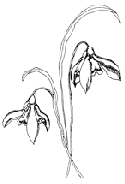
But at least we have some snowdrops.... in amongst the fungi.

You can see what fun I have ahead of me, in between decorating the house..... or should I say, decorating the house in between doing the garden! :D  I have to admit to having been feeling very sorry for myself, as I clean all the clods of muck off the carpets that the dogs are bringing in, despite wiping their feet - wiping 3 sets of paws at regular intervals becomes tiring after a while...... then I read an article from Pan Magazine ....... and I realised I have the 'stuff of stars' on all my carpets. :D


"A teaspoon of living soil contains a million bacteria, 20 million fungi, 1 million protozoa, and 200,000 algae - a stupendous reservoir of genetic materials that have evolved continuously since the dawn of the earth.  These micro-organisms are busily engaging in photosynthesis at the surface.  They fix nitrogen to roots.  They bury carbon that is then released back into the air through the transformation of organic matter into carbon dioxide, a process known as soil respiration. 

The soil is active.  The soil is alive.  The soil is a life related to our own life.  And our very sustenance comes from the soil.  Billions of years ago, the same carbon that is in our bodies today exploded from a supernova, became the stuff of stars and helped give rise to the planets."

(excerpt taken from Pan Magazine, Autumn 2005 - Pan Magazine is published by the World Pantheist Movement)

Tuesday, February 1, 2011

Save Our Forests!


 The British Government is planning on selling off our publicly-owned forests.  Since organisations such as The National Trust, etc. will not be able to compete with property developers, the forests could end up being replaced by holiday resorts, golf courses and adventure playgrounds.  It would be an environmental disaster.

I am joining forces with the many other bloggers who have already brought this to our attention.  Act now while there is still time.  Follow the link below to sign the petition to save our ancient forests.


http://38degrees.org.uk/

Saturday, January 29, 2011

My mum...........


For the past year my mum, who is now 86, has been in decline.  We visited mum and dad today and I came home with mixed feelings.  She smiled and laughed today for the first time in a year.  Depression and indifference seems to have been all she has known as the ageing process takes a stronger hold - yet, today, her blurred thoughts and confused mind somehow caused her to forget what she's been depressed about, and she chuckled and smiled.  It was good to see....  yet sad also, to look on this little old frail woman who is my mum - the person that gave me so much of what is good in my life.

Both my parents love plants and the garden my older brother and I grew up with was a joy.  There was something in it for all of us.  Mum and dad had their rose garden.  Together, they would choose some new roses from a catalogue on an annual basis, and they would let Ian and I choose one too.  My dad didn't do things by half..... he used to test the soil for its acid and alkaline content, add various organic materials to it so it would be perfect for the roses which he would prune at just the right angle and at just the right time.  He even got to be quite an expert at grafting them too.  He laid pipes under the soil to help with the drainage and he especially liked to take care of the lawns by carefully edging them, mowing them and then going over them with a roller.  

Despite the attention lavished on the garden, it wasn't a show garden.  My dad made a mini putting course on one of the lawns, complete with holes and markers.... and we were always having picnics on the grass, especially when joined by members of the extended family.  We were never told to keep off the grass or not to pick this or that, etc.  It was a garden that was enjoyed by the family.  Against one wall was the rabbit hutch and run that my dad built.  One day mum got in a panic because she thought I had disappeared with my friend, when all the time we had snuck inside the rabbit hutch along with Candy, Floss and Titch!  On one of the borders was a section that was given to me, where I learned to grow my first seeds..... radishes.

Mum always had a vase of cut flowers in the living-room, taken from our garden and when I gave birth to my eldest son in hospital, dad brought me a huge bunch of roses, mixed with other garden blooms - the nurses admired them so much that he brought a bunch for them at his next visit.  

I remember a navy cord jacket that mum wore when I was a child.  To me, it seemed to smell of plums!  Then, one day when I was much older, I was walking beside the river and I could smell that familiar scent. After a while,  I realised it was coming from the Himalayan Balsam that was growing alongside the river...... the scent was just like mum's jacket!  So now, the scents that I associate with my mum are plums, Himalayan Balsam...... and most of all, her favourite perfume - Coty L'Aimant (which has nothing at all to do with gardening!). 

I'm so glad that my parents were not only such keen gardeners, but that they allowed my brother and I to enjoy the garden without the fear of 'spoiling' anything in it.  My love of the outdoors has been gifted to me by my parents, but not only that - my faith also, for it was in the outdoors that I found it.  I love you mum and dad.


Sunday, January 23, 2011

Gathering Moss by Dr Robin Wall Kimmerer

Gathering Moss - A Natural and Cultural History of Mosses
By Robin Wall Kimmerer

I've had this book for some time now and dipped into it numerous times.  It's a book I will never tire of and new bits of information stand out with each reading.  Robin Wall Kimmerer is  Professor of Environmental and Forest Biology at the State University of New York College of Environmental Science and Forestry.  

This is not just a book on identifying mosses - it is much more than that.  Dr Kimmerer writes beautifully and passionately with a scientific mind and also a mind that has come to know the environment intimately through her native american heritage.  She tells the story of mosses in language that does not necessitate the need for being a botanist to understand - how these amazing plants "live and how their lives are intertwined with the lives of countless other beings."  (quote from the back cover) 


Robin Wall Kimmerer

"I think it is this that draws me to the pond on a night in April - tadpoles and spores, egg and sperm, mind and yours, mosses and peepers - we are all connected by our common understanding of the calls filling the night at the start of Spring.  It is the wordless voice of longing that resonates within us, the longing to continue, to participate in the sacred life of the world."  Robin Wall Kimmerer


An excerpt from the chapter, An Affinity for Water, pages 39 & 40:-

"Watch a drop of rainwater fall on a broad, flat oak leaf.  It beads up for a minute, reflecting the sky like a crystal ball, and then slides off to the ground.  Most tree leaves are designed to shed water, leaving the task of water absorption to the roots.  Tree leaves are covered with a thin layer of wax, a barrier to water entering by absorption or leaving via evaporation.  But moss leaves have no barrier at all, and are only one cell thick.  Every cell of every leaf is in intimate contact with the atmosphere, so that a raindrop soaks immediately into the cell.  

The leaves of trees are uniformly flat, to intercept as much light as possible, and spaced far from one another to prevent shading.  But light is of less concern to mosses than is water.  Therefore, the nature of moss leaves is entirely different from trees.  Each leaf is shaped to make a home for water.  Lacking roots or an internal transport system of any kind, mosses rely entirely on the shape of their outer surfaces to move water.  In some species, the flow of water is accelerated by the wicking action of minute threads, or paraphyllia, that densely cover the moss stem, like a blanket of coarse wool.  The shape and arrangement of some moss leaves collect and retain water, a concave leaf holding a single raindrop in its upside-down bowl.  Others have long leaf tips, rolled into tiny tubes that fill with water and channel the droplets to the leaf surface.  Leaf overlaps leaf, closely spaced, creating tiny concave pockets, a continuous conduit for water moving among them."

Dr Kimmerer's book is a joy to read and would make a wonderful gift, either to yourself, or to someone you know who is fascinated by these wonderful plants.
 
From the preface:- 
 
"In indigenous ways of knowing, we say that a thing cannot be understood until it is known by all four aspects of our being:  mind, body, emotion, and spirit.  The scientific way of knowing relies only on empirical information from the world, gathered by body and interpreted by mind.  In order to tell the mosses' story I need both approaches, objective and subjective.  These essays intentionally give voice to both ways of knowing, letting matter and spirit walk companionably side by side.  And sometimes even dance."


Go here to read more about Robin Wall Kimmerer

For anyone interested in studying mosses and even growing them, go here for a fantastic download.


Wednesday, January 19, 2011

Seeds is a synonym for joyful promise


During the month of January the weather can be a bit hit and miss.  Some days you can get out into the garden to work, most days you cant.... whether it's because of rain or a hard frost, like today.  One of the activities I enjoy at this time is all the extra feeding of the garden birds and watching them from the warmth of the house..... another is planning on which seeds I'll be sowing.


I'm particularly fond of Sweet Peas and I've got some different ones to grow this Summer.  This one (above) is Royal Family mix. 


This one (above) is Air Warden


Above is Old Spice Starry Night

Sweet Peas are so obliging - their germination rate is excellent, they grow well with very little attention, they come in colours to suit everyone and, best of all, the majority of them are scented.  Furthermore, the more you pick the flowers, the more they will send out new blooms..... so, throughout the Summer you can have cut flowers for the house and flowers in the garden right up till Autumn.  Perfect!


Hyssop officinalis - blue

Hyssop is an evergreen bushy herb that can be used in cooking and for medicinal purposes.  The list of its health benefits is endless.... everything from digestive problems to treating wrinkles - think I'll be making myself some hyssop oil this year!  I especially want to grow it because it looks pretty and I love the shade of blue of its flowers.  I've also got some seeds of the white variety to try as well.  I've got a small section of the garden set aside for herbs - it will be growing in amongst lemon balm, parsley, rosemary and angelica.


Borago officinalis

Borage is another herb with pretty blue flowers.  It's sometimes referred to as Starflower because of the shape of the flowers.  You can make an infusion with the leaves - it has a subtle cucumber taste and makes a nice refreshing drink for hot Summer days. Both the flowers and leaves can be used in salads and if you pop a flower in each of the ice cube compartments, they make a healthy addition to your drinks.   Borage contains a host of vitamins and minerals and is particularly helpful to people with respiratory complaints.


Cichorium intybus

Chicory is a perennial herb.  The roots, when ground and roasted, make a healthy substitute for coffee and is said to cleanse the blood and improve the health of the liver.  The young leaves can also be used in salads.


 Sweet Pea Help for Heroes


The seed and plant company, Mr Fothergills is donating £1 for every packet of Sweet Pea Help for Heroes that is bought, to the charity of the same name.  Go here to buy your packet.


I found this lovely poem about the joys of seeds.


He Knows No Winter


He knows no winter, he who loves the soil,

For, stormy days, when he is free from toil,

He plans his summer crops, selects his seeds

From bright-paged catalogues for garden needs.

When looking out upon frost-silvered fields,

He visualizes autumn's golden yields;

He sees in snow and sleet and icy rain

Precious moisture for his early grain;

He hears spring-heralds in the storm's ' turmoil­

He knows no winter, he who loves the soil.


SUDIE STUART HAGER